
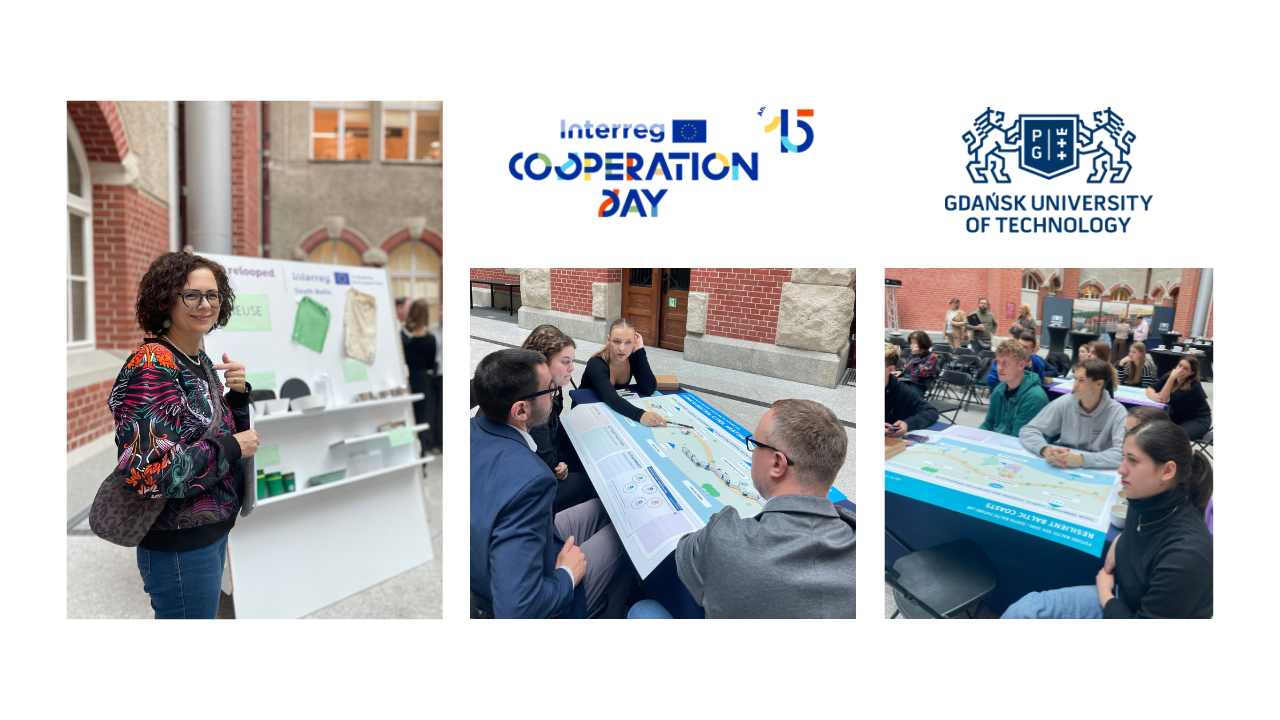
On November 3, 2026, representatives from Interreg projects and regional institutions gathered at Gdańsk University of Technology for Interreg Cooperation Day: “Future Baltic Sea 2040”. Hosted in the atmospheric Hevelius Yard, the event provided an engaging space for project partners and students to explore how individual solutions can combine to address shared challenges across the South Baltic region.
The event brought together key regional institutions, including Gdańsk University of Technology, the University of Gdańsk, the Institute of Fluid Flow Machinery, the Gdańsk Entrepreneurship Foundation, the Pomeranian Agricultural Advisory Centre, DOT Energy, CPL Competence in Ports and Logistics GmbH, and the INWL Institute for Sustainable Economy and Logistics.
Together, these organisations represented a wide range of Interreg South Baltic initiatives focusing on crucial sectors:
- Energy Transition & Farming: BIOSOLFarm, Re-Farm, LoCaGas, Watt a Waste, BALTICBEAT, DeCoInter
- Low-Carbon Cities & Heating: SBEES, BES – Baltic Enershift, DecarbonDHS
- Circular Economy: BePacMan, Strive, Relooped
- Baltic Coastal Resilience: Baltwreck, ECONUT, PortSHAZ
- Tourism, Digitalisation & Capacity Building: LAL, BIOCHAR4SBR, Back2Woods
Designed to promote practical exchange, the workshop kicked off with a project “speed-dating” session. Representatives introduced their ongoing work, highlighted the challenges they are addressing, outlined the resources and expertise they offer, and identified areas where they need support from other sectors.
Following speed-dating, participants split into five thematic working groups:
- Energy-positive farms and rural areas
- Climate-neutral cities, heating, and mobility
- Clean industry and circular production
- Resilient Baltic coasts
- Sustainable tourism and cross-border communities
In these groups, teams mapped out existing project solutions, identified gaps and common needs, and brainstormed new concepts for cross-border collaboration.
The day concluded with an interactive mapping exercise of the South Baltic region. Working on a large-scale map, teams placed physical models of their solutions and drew connections between different projects, places, and resources.
The resulting map serves as a tangible vision of how cross-border cooperation can deliver lasting environmental, social, and economic benefits to the region by 2040.